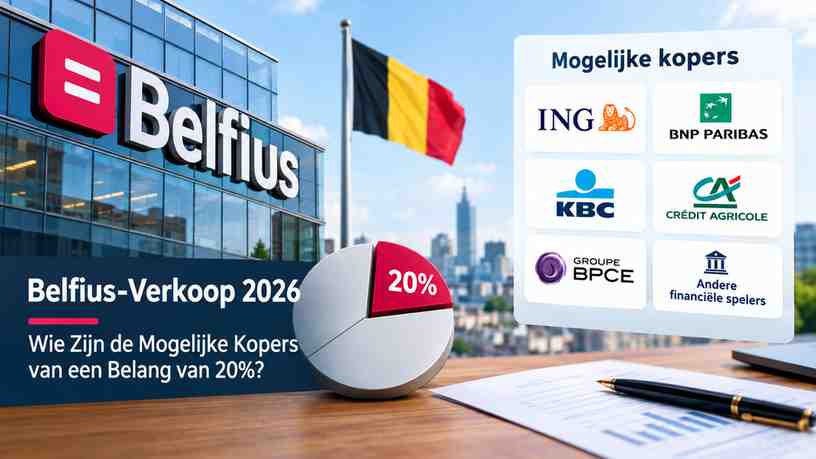
Belgium has formally started preparations to sell up to 20% of Belfius Bank in 2026. The transaction is attracting attention because Belfius is one of Belgium’s largest financial institutions and remains fully controlled by the Belgian state. However, no buyer has been officially confirmed. Names such as ING, Rabobank, Crédit Agricole and investment firm CVC have appeared in media reports, but they should be treated as potential candidates—not announced bidders.
For Indian readers searching for “Belfius kandidaten” or Belfius-Verkoop 2026: Wie Zijn de Mogelijke Kopers van een Belang van 20%?, the key point is simple: the sale is a private placement aimed at qualified investors, and the final shortlist will depend on regulatory, financial and strategic assessments.
What is happening in the Belfius sale?
The Belgian federal government decided in December 2025 to begin preparations for a partial sale of Belfius. SFPIM, Belgium’s Federal Holding and Investment Company, currently holds Belfius shares on behalf of the state.
In June 2026, Belgium’s Council of Ministers approved a delegated mandate allowing SFPIM to organise the sale of a stake representing a maximum of 20% of Belfius’ capital. SFPIM is responsible for identifying one or more suitable buyers, setting eligibility criteria and signing the necessary transaction agreements. The government will receive periodic progress reports. News.belgium’s official announcement describes the structure of the mandate.
The process is not an initial public offering. Instead, the government has chosen a negotiated sale to private investors. This approach gives Belgium more control over the identity of the shareholder, the timetable and possible conditions attached to the investment.
SFPIM appointed BofA Securities as its sole financial adviser. The official invitation asked interested parties to submit an expression of interest by 3 July 2026. Only candidates meeting the definition of qualified investors, or equivalent rules accepted for another jurisdiction, can participate. SFPIM also reserves the right to delay or stop the process. SFPIM’s invitation to express interest confirms these conditions.
Why is Belgium selling 20%?
The sale has several objectives.
First, it can generate cash for the Belgian treasury and help reduce public debt. Belgian media estimates have placed the potential proceeds at roughly €2 billion, although the final amount will depend on valuation, negotiations and market conditions.
Second, the transaction would open Belfius’ capital to an external shareholder without giving up state control. A 20% investor could obtain an economically meaningful position while the Belgian government remains the majority owner.
Third, a strategic investor could bring additional expertise, distribution capacity or technology partnerships. Belfius operates as a universal bank and insurance group, serving retail, business and institutional customers in Belgium.
The sale also reflects a broader European trend. Governments are reviewing stakes acquired during earlier financial crises, while well-capitalised banks are examining cross-border expansion and consolidation opportunities.
Belfius’ business makes the stake attractive

Belfius is not a small regional lender. Its activities cover retail banking, corporate banking, public and social banking, insurance, payments and asset management. The bank’s 2026 base prospectus states that all ordinary shares are held through SFPIM, with the vast majority held on behalf of the Belgian state. It also reports a consolidated balance sheet of approximately €193 billion at the end of 2025. Belfius’ 2026 base prospectus provides the detailed ownership and financial information.
The institution has an essentially Belgian commercial footprint, a large domestic customer base and a recognised brand. For a foreign bank, buying 20% could offer exposure to Belgium without the cost and political sensitivity of an immediate full takeover.
The investment could also provide influence through shareholder rights, depending on the final agreement. However, a 20% stake does not automatically mean management control. Governance rights, board representation, veto provisions and dividend policy would need to be negotiated and approved.
Possible Belfius buyers: who is being mentioned?
ING
ING is one of the most frequently cited candidates. It already operates in Belgium and competes in retail and business banking. A stake in Belfius could give ING additional scale, customers and product capabilities in a market where it already has infrastructure.
The challenge is competition policy. ING is already a major Belgian banking player. Regulators would examine whether a significant investment in Belfius could reduce competition, affect branch coverage or limit consumer choice.
ING’s existing Belgian presence is therefore both its strongest advantage and its biggest regulatory complication. Media reports have mentioned possible interest, but ING has not publicly confirmed a bid.
Rabobank
Rabobank is another name reported by Belgian and Dutch financial media. The cooperative Dutch bank has substantial capital and international activities, particularly in food, agriculture and business finance.
A Belfius investment could give Rabobank a route back into Belgian retail banking after reducing its previous consumer-banking presence there. The historical connection is also notable: Rabobank chief executive Stefaan Decraene previously led Dexia Bank Belgium, Belfius’ predecessor.
Rabobank could potentially bring expertise in corporate, agricultural and cooperative finance. Nevertheless, it would need to demonstrate how a minority investment fits its long-term strategy and governance model.
Crédit Agricole
French banking group Crédit Agricole has also been mentioned as a possible interested party. It has experience in European retail banking, insurance and asset management, and already operates across several countries.
A Belfius stake could complement Crédit Agricole’s regional network and provide access to Belgian customers and institutional relationships. Its diversified business model may also make it a credible long-term financial investor.
The main questions would involve strategic overlap, regulatory approval and whether Crédit Agricole wants a minority position rather than a larger acquisition.
CVC and other financial investors
Investment firm CVC has appeared in media speculation alongside banking candidates. A private-equity investor would assess Belfius primarily as a financial asset, focusing on earnings, capital generation, dividends and the potential value of a future exit.
A financial investor may be less affected by competition concerns than an existing Belgian bank. However, Belgium may prefer a shareholder that supports Belfius’ long-term role in the domestic economy rather than one seeking a relatively short investment horizon.
Other European banks, pension funds, sovereign investors or infrastructure-style funds could also examine the opportunity. The official process is open to eligible qualified investors, so the final field may be broader than the names currently reported.
What makes a successful buyer?
SFPIM is likely to assess more than the highest price. Important criteria could include:
- Financial strength and ability to complete the purchase
- Regulatory reputation and approval prospects
- Long-term commitment to Belfius
- Experience in banking and insurance
- Treatment of employees and Belgian operations
- Governance and board arrangements
- Capital support for future growth
- Compatibility with Belfius’ risk profile
- Restrictions on resale or transfer of the shares
A buyer proposing a slightly lower price but offering greater stability could be more attractive than a bidder seeking aggressive restructuring.
Why a stock-market listing was not selected
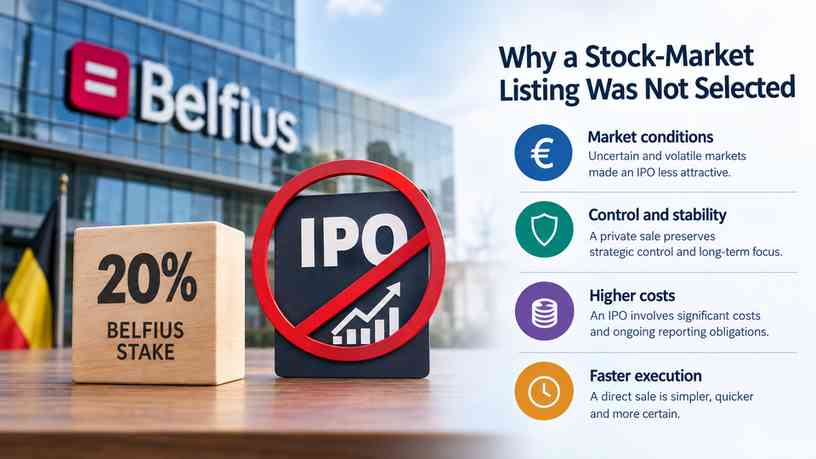
A public listing would have allowed a wider range of investors to buy Belfius shares. However, an IPO would expose the government to market volatility, complex preparation requirements and uncertainty about the final valuation.
A private placement can be executed with fewer investors and allows Belgium to negotiate shareholder protections. It also avoids immediately subjecting Belfius to the daily price fluctuations and disclosure expectations of a listed company.
The disadvantage is reduced transparency for ordinary investors. Most retail savers, including investors in India, will not be able to participate directly in this stage.
What does the sale mean for Belfius customers?
For customers, a 20% sale should not automatically change accounts, cards, loans or insurance policies. Belfius would continue operating under Belgian banking supervision, and existing contracts would remain governed by their terms.
The practical impact would depend on the buyer’s strategy. A bank could seek cost savings or product integration, while a long-term financial investor might prioritise dividends and operational continuity. Belgium’s government is expected to consider employment, headquarters and strategic-interest concerns during negotiations.
Customers should therefore watch for official announcements rather than assume that a reported candidate will become Belfius’ new shareholder.
Can Indian investors buy the Belfius stake?

The official process is designed for qualified investors, not a public retail offering. An Indian bank, investment fund or institutional investor could theoretically explore eligibility under applicable Belgian, European and Indian rules, but participation would require regulatory, legal and financial approval.
Indian individual investors should not expect to purchase Belfius shares through a normal stock-broking account. Belfius is not being offered as a publicly traded Indian security, and the 2026 process does not represent an opportunity comparable to buying shares on the NSE or BSE.
Any Indian institution considering the transaction would need specialist advice on foreign-exchange rules, overseas investment limits, banking regulation, tax treatment and disclosure obligations.
Timeline and what happens next
The expression-of-interest stage began with the SFPIM invitation and a July 2026 launch timetable. Eligible candidates would then receive further information from BofA Securities, potentially including confidentiality documents, financial data and bidding instructions.
The likely sequence is:
- Eligibility screening of interested investors
- Access to transaction information
- Indicative or non-binding offers
- Due diligence and regulatory review
- Negotiation of final agreements
- Selection of the preferred buyer
- Completion after all approvals
The process may take longer than expected. SFPIM has explicitly retained the right to delay or discontinue it, and no completion date or final price has been guaranteed.
FAQ
Who owns Belfius today?
SFPIM holds Belfius shares on behalf of the Belgian state. Belfius’ 2026 prospectus confirms that essentially all ordinary shares are controlled through SFPIM.
Is ING confirmed as a Belfius buyer?
No. ING has been mentioned in media reports as a possible candidate, but there is no official confirmation that it has submitted a binding offer.
Why are Rabobank and Crédit Agricole interested?
Both have European banking operations, capital resources and potential strategic reasons to expand in Belgium. Their actual interest and eligibility remain subject to the formal sale process.
Will Belfius become publicly listed in 2026?
The announced transaction is a private placement of up to 20%, not an IPO. A future listing cannot be ruled out, but it has not been announced as part of this sale.
Can ordinary Indian investors participate?
Generally, no. The offer is restricted to qualified investors and is not a public retail share sale available through Indian exchanges.
When will the final buyer be known?
No final buyer or guaranteed closing date has been announced. The outcome depends on bidding, due diligence, regulatory approvals and SFPIM’s decision.
Bottom line
The answer to Belfius-Verkoop 2026: Wie Zijn de Mogelijke Kopers van een Belang van 20%? (Belfius kandidaten) is that ING, Rabobank, Crédit Agricole and CVC are among the names reported by financial media, while the official process remains open and no bidder has been confirmed.
The sale is strategically important because it could raise substantial funds for Belgium while introducing a powerful minority shareholder into Belfius. For now, investors and customers should separate verified facts from speculation: SFPIM has started the process, BofA Securities is managing it, qualified investors are being screened, and the identity of the eventual buyer is still undecided.