Belgian Cats Fans Reageren op de Uitschakeling tegen Duitsland with a mix of disappointment, realism and continued pride in a team that has raised expectations for Belgian women’s basketball. Belgium’s medal hopes ended on 10 September 2026, when host nation Germany won the FIBA Women’s Basketball World Cup quarter-final 93–74 in Berlin.
For supporters, the result was hard to accept not simply because Belgium lost, but because the Belgian Cats never consistently found the fluent, connected style that has made them one of Europe’s most respected teams. Germany were sharper, more physical and more efficient over four quarters, turning a promising Belgian start into a decisive home-court victory.
The result: Germany 93–74 Belgium

The quarter-final at Berlin Arena began with Belgian promise. The Cats led early, with Emma Meesseman setting the tone, but Germany gradually took control through shooting, pace and defensive pressure.
The quarter-by-quarter score tells the story:
| Quarter | Belgium | Germany |
|---|---|---|
| First | 19 | 22 |
| Second | 16 | 20 |
| Third | 24 | 32 |
| Fourth | 15 | 19 |
| Final | 74 | 93 |
Belgium stayed within reach at half-time, trailing 35–42. However, Germany’s 32-point third quarter became the turning point. The hosts repeatedly punished defensive gaps, while Belgium struggled to create the sustained ball movement and shot quality needed for a comeback.
Germany finished with a stronger overall field-goal percentage, particularly inside the arc, and made better use of their athleticism and depth. The 19-point margin was a harsh reflection of a game in which Belgium had moments of resistance but never managed to seize momentum for long.
Why Belgian Cats fans are so disappointed
Belgian fans did not travel to Berlin merely hoping for a respectable tournament. After recent international success and the Cats’ established status among Europe’s elite, a World Cup medal was a realistic ambition.
That is why the reaction has been so emotional. Supporters saw a squad capable of beating major opponents, led by one of the world game’s outstanding players in Meesseman. The quarter-final exit therefore feels less like a routine defeat and more like a missed opportunity.
The strongest reactions have centred on three themes:
- Belgium were outplayed in too many key areas.
- The team did not display its usual collective rhythm.
- A single poor knockout performance can erase months of preparation and group-stage progress.
There is also recognition that Germany deserved the win. Playing at home in front of a loud Berlin crowd, the Germans brought greater intensity after the opening minutes and maintained it. For Belgian supporters, that acknowledgement does not soften the disappointment, but it does place the result in context.
Emma Meesseman’s performance could not change the outcome
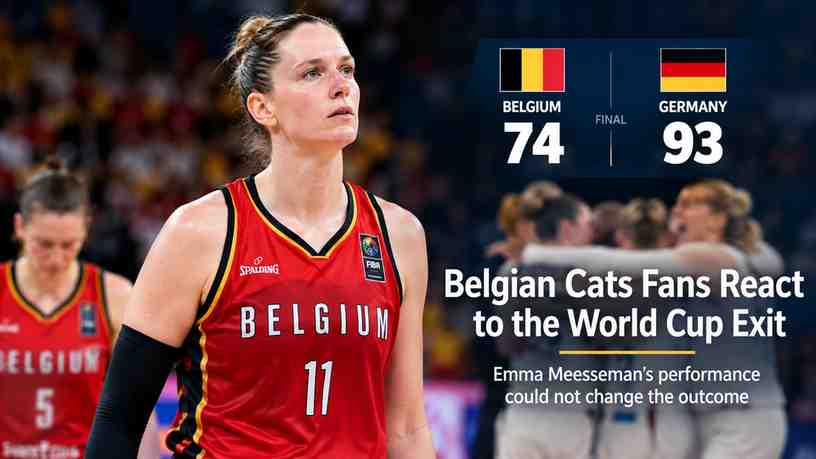
Emma Meesseman again carried a major share of Belgium’s responsibility, scoring 30 points in the official FIBA game record. Her output underlined both her class and the challenge facing the Cats: one elite individual performance was not enough against a German side that received contributions across the floor.
Meesseman’s post-game reaction was notably direct. She spoke of a defeat the team would carry with them and acknowledged that Belgium fell short in shooting, aggression, physicality and ball movement.
That honesty has resonated with fans. Belgian supporters are used to seeing a team built on shared decision-making, quick passing and collective confidence. Against Germany, too many possessions became difficult, too many defensive stops were missed, and the Cats could not establish the control that defines their best basketball.
Julie Allemand’s assessment reflects the wider frustration
Julie Allemand’s response after the loss captured the mood around the team. She pointed to Germany’s efficiency, Belgium’s inability to play its preferred rhythm and an overall defensive performance that conceded far too much.
Allowing 93 points in a World Cup quarter-final gives any opponent a strong platform to win. Germany’s accuracy and athletic presence prevented Belgium from settling. When the Cats tried to reduce the gap, Germany found answers quickly enough to stop a genuine late-game surge.
For fans, the frustration is not directed at one player or one possession. The disappointment is broader: Belgium were beaten collectively by a side that executed more effectively on the day.
The third quarter that changed Belgium’s World Cup

The match was not decided in the first quarter, despite Germany taking a 22–19 lead. Nor was the seven-point half-time deficit impossible to recover from. Belgium had been in difficult situations before and had earned a reputation for resilience.
The decisive phase came after the interval.
Belgium scored 24 points in the third quarter, which is normally a competitive return. Germany, however, scored 32. That meant every Belgian attempt to regain ground was offset by a German response. The gap widened, pressure grew and the Cats entered the final quarter facing an increasingly unlikely task.
In knockout basketball, a few minutes can define an entire tournament. Germany’s ability to convert that period into separation was the difference between Belgium remaining in the medal race and heading home early.
A home crowd mattered, but it was not the whole explanation
More than 10,000 spectators attended the game in Berlin, creating a strong home environment for Germany. The atmosphere clearly gave the hosts energy, especially during their runs and defensive sequences.
Yet Belgian Cats fans should avoid reducing the result solely to crowd advantage. Germany earned the victory on the court. They shot better, handled Belgium’s pressure well and imposed a more physical game.
The home support was an important factor, but the larger issue was Germany’s execution. Belgium needed to match that intensity, then add its own characteristic creativity. It did not happen often enough.
Is this a failure for the Belgian Cats?

The answer depends on the standard being used.
At a basic level, reaching a World Cup quarter-final remains an achievement. International women’s basketball is deep, and knockout games leave little room for error. Belgium remain a significant force with experienced leaders and a proven record of competing against top nations.
But from the perspective of this specific campaign, the exit falls short of the team’s own ambitions. Belgium had spoken about competing for a medal, and the defeat ended that possibility before the semi-finals.
This was also the third straight Women’s World Cup in which the Belgian Cats’ journey ended at the quarter-final stage. That pattern will naturally prompt questions about what must change for Belgium to convert quality and potential into a World Cup medal.
The right response is neither panic nor complacency. Belgium have too much talent and too much recent success for one loss to define the programme. At the same time, the margin against Germany shows that the standard at the top of the women’s game continues to rise.
What Belgian fans can take forward
The immediate reaction is understandably negative. Fans invested time, travel and emotion in the tournament, and many had expected the Belgian Cats to go much further.
Still, there are reasons for perspective.
First, Belgium’s core players remain capable of competing with anyone. Meesseman’s 30 points against Germany were another reminder of her level. Second, the disappointment is rooted in high expectations, which is itself evidence of how far the programme has progressed. A quarter-final exit now hurts because Belgian basketball supporters believe their team belongs in the medal conversation.
Finally, difficult defeats can become useful reference points. The Cats will need to analyse their defence, offensive rhythm, depth and ability to respond when an opponent gains control. The players’ own candid comments suggest they understand that responsibility.
What comes next for the Belgian Cats?
The immediate World Cup dream is over, but the wider project continues. Belgium’s challenge is to ensure that this defeat becomes a lesson rather than a label.
The next phase should focus on maintaining the team’s identity while preparing for increasingly athletic and well-organised opponents. Belgium are at their best when they move the ball quickly, trust multiple scorers and defend with collective commitment. Those principles remain valid; they simply must hold up under knockout pressure.
For supporters, the sensible response is to stay demanding while continuing to back the team. The Belgian Cats have earned that support through years of progress, memorable wins and a style of basketball that has helped grow the women’s game in Belgium.
FAQ
What was the Belgian Cats’ score against Germany?
Belgium lost 74–93 to Germany in the 2026 FIBA Women’s Basketball World Cup quarter-final in Berlin.
Why were the Belgian Cats eliminated?
Germany were more efficient in shooting, stronger physically and more consistent across the game. Their 32-point third quarter created the decisive gap.
How many points did Emma Meesseman score against Germany?
Emma Meesseman scored 30 points for Belgium in the quarter-final defeat.
Did Belgium lead at any point against Germany?
Yes. The Belgian Cats started well and led during the opening stages, but Germany took control before the end of the first quarter.
Was Germany playing at home?
Yes. Germany hosted the 2026 Women’s Basketball World Cup quarter-final in Berlin and had strong home support in the arena.
Should Belgian Cats fans be worried after this defeat?
The defeat exposes areas Belgium must improve, especially against elite physical opponents. However, the squad’s talent, experience and recent international record remain strong reasons for confidence.