Belgium’s E17 motorway connects Antwerp, Ghent, Kortrijk and the French border. It is one of the country’s busiest freight and commuter routes, which means crashes can quickly create long queues. The answer to “E17 Ongevallen: Welke Wegvakken Zijn het Gevaarlijkst in België?” is not a single permanent black spot. Risk changes with traffic, roadworks, weather and congestion.
Based on the most detailed public analysis available from VRT NWS, the E17 sections that deserve the most attention are:
- The approach to Antwerp around Zwijndrecht and the Kennedytunnel
- The E17 near Destelbergen and Gentbrugge
- The stretch between Deinze and De Pinte
- Congested interchange areas around Ghent and Zwijnaarde
The ranking below should be read carefully. VRT’s motorway comparison examined reported crashes from 1 January 2020 to 15 May 2021, combining Flemish Traffic Centre information with Flitsmeister reports. It is not a live government league table. Current traffic data confirms that the E17 remains among Flanders’ busiest motorways, while the precise order of dangerous sections can change over time. VRT NWS explains its methodology and E17 hotspots and the Flemish Traffic Centre’s 2024 report provides the latest broad traffic context.
1. Zwijndrecht to the Antwerp ring and Kennedytunnel approaches
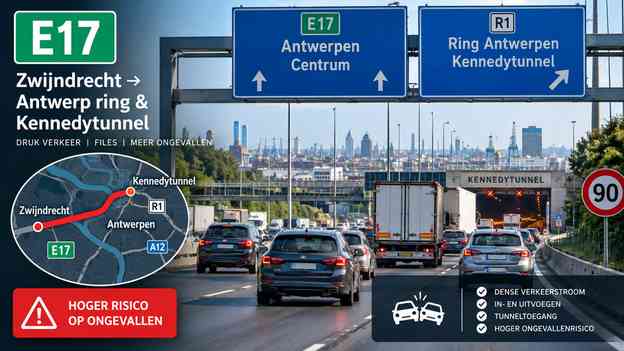
The E17’s northern end is one of its most demanding driving environments. Near Zwijndrecht, traffic from the motorway merges with vehicles heading towards Antwerp, the R1 ring road, the A12 and the E34. Drivers must often choose lanes within a short distance while heavy goods vehicles occupy the right lanes.
VRT describes the E17 at Zwijndrecht as one of the busy motorway sections feeding Antwerp’s ring. The problem is not simply speed. It is the combination of:
- Dense commuter and freight traffic
- Short distances between exits and lane splits
- Last-minute lane changes
- Stop-and-go queues
- Drivers failing to notice the end of a traffic jam
The Kennedytunnel adds another layer of complexity. Vehicles enter and leave an underground structure while traffic lanes narrow and speed limits can reduce to 70 km/h around the ring-road system. A minor rear-end collision can block a lane and produce a much larger queue.
For drivers unfamiliar with Belgian motorways—including Indian visitors using a rental car—advance lane planning is essential. Check the route before entering the Antwerp area, follow overhead signs early and avoid crossing several lanes just before a tunnel or interchange.
2. Destelbergen and Gentbrugge: a historically severe crash area
The E17 near Destelbergen, towards Kortrijk, gained a particularly poor reputation during the long renovation of the Gentbrugge viaduct. VRT placed two E17 locations near Ghent high in its list of crash-prone motorway sections. Serious collisions were reported during periods when traffic lanes, road layouts and queue patterns changed.
Construction zones create risk because drivers must process unfamiliar information quickly:
- Temporary lane markings
- Narrower lanes
- Reduced speed limits
- Sudden lane closures
- Queues forming behind bends or over crests
- Heavy vehicles changing lanes near work areas
The Flemish Traffic Centre reported that 2024 was a record year for congestion on Flemish motorways, with an average of 26 “hindrance crashes” per working day—collisions that partially block or close a motorway. November averaged 33 such incidents per working day. These figures cover all Flemish motorways, not only the E17, but they show why queue-end collisions remain a major concern.
Additional dynamic warning signs and police enforcement around the Ghent works were associated with a reduction in the severity of incidents, according to VRT. That is an important distinction: a section may continue to experience crashes while engineering, warnings and enforcement reduce the number of serious injuries.
3. Deinze–De Pinte: a recurring E17 risk section
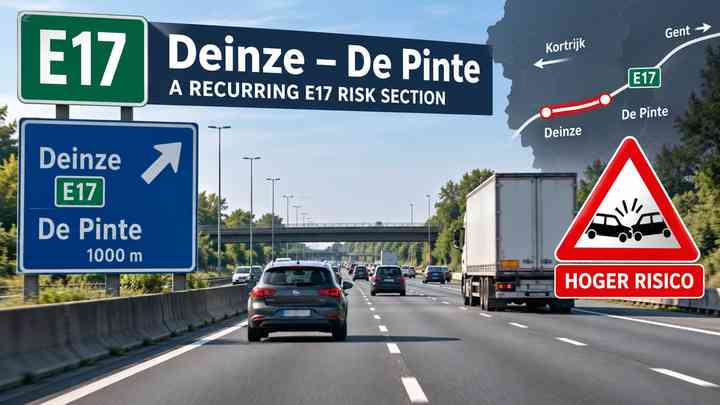
The E17 between Deinze and De Pinte is another section identified by VRT as having a concerning crash profile. It lacks the dramatic tunnel-and-ring-road complexity of Antwerp, but traffic volumes and merging movements still create danger.
This area carries long-distance traffic between Ghent, Kortrijk and northern France, alongside local commuters. Typical risk factors include:
- Speed differences between cars and trucks
- Overtaking queues in the middle lane
- Drivers moving left without checking blind spots
- Sudden braking caused by congestion farther ahead
- Wet-weather loss of grip
- Fatigue on longer cross-border journeys
On a motorway, safe spacing is more valuable than constantly changing lanes. If traffic is heavy, keep a substantial gap and anticipate that the vehicle ahead may brake suddenly. When passing a lorry, complete the manoeuvre smoothly and return only when there is adequate space.
4. Ghent interchanges and the Zwijnaarde area
The Ghent region is a strategic junction for traffic travelling between Antwerp, the coast, France and inland Belgium. The E17 interacts with the R4 ring and other major routes, so congestion can spread quickly when one road is obstructed.
The Flemish Traffic Centre reported that works around the Zwijnaarde interchange in 2024 pushed additional traffic onto the southern R4. Diversions do not automatically make the E17 unsafe, but they can change traffic patterns and increase unfamiliar merging movements.
Interchange danger usually peaks during weekday rush hours and at the start or end of holiday periods. Weekend traffic is also becoming more important: the 2024 Flemish report recorded a 1.3% increase in Saturday traffic and a 2.4% increase on Sundays compared with 2023.
Drivers should be especially alert when navigation software reroutes them. A sat-nav instruction may encourage a late exit manoeuvre, but motorway signs and lane discipline should take priority. If you miss an exit, continue to the next safe junction rather than stopping or reversing.
Why does the E17 experience so many crashes?
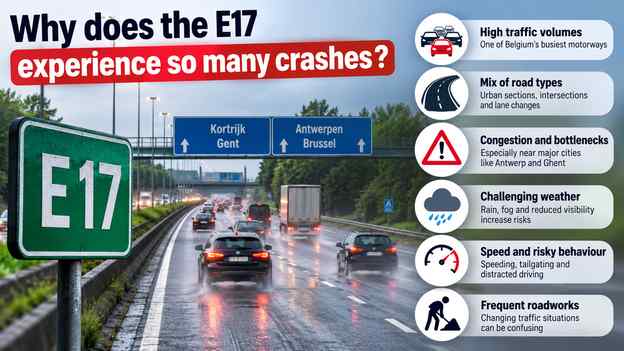
Traffic density and mixed vehicle types
The E17 carries private cars, coaches, vans and international trucks. Heavy vehicles accelerate and brake differently from cars, creating speed variations that become dangerous in crowded lanes.
Queue-end collisions
Many motorway crashes occur when a driver notices a stationary or slow-moving queue too late. Distraction, mobile-phone use, fatigue and poor visibility all increase this risk.
Frequent lane changes
Near Antwerp and Ghent, exits, ring roads and motorway connections appear close together. Drivers who remain in the wrong lane may attempt an abrupt manoeuvre, often without allowing enough distance.
Roadworks and temporary layouts
Even a well-designed motorway becomes harder to read when lanes shift or the hard shoulder is unavailable. Reduced speeds are intended to protect road workers and give drivers more reaction time.
Rain, spray and darkness
Belgian weather can change quickly. Water spray from trucks reduces visibility, while wet road surfaces increase stopping distances. A speed that feels comfortable in dry daylight may be excessive in heavy rain.
How Belgian authorities identify dangerous road sections
Belgium does not treat every crash location as a permanent black spot. Flanders uses historical and dynamic lists of dangerous points, covering both intersections and road segments. The dynamic list is updated using recent crash data and is intended to identify locations where road design contributes to collisions.
A 2025 evaluation by the Flemish government and Vias institute found that treated dangerous locations experienced a 24% reduction in injury crashes and a 28% reduction in traffic victims. Structural redesigns performed better than minor “quick win” measures, although markings, circulation changes and signals also produced measurable benefits. The Flemish government published the evaluation results here.
This approach matters for the E17 because a section can improve after resurfacing, barrier installation, better signs or interchange redesign. Conversely, new construction or a traffic diversion can temporarily create fresh risks.
Practical E17 safety advice for Indian travellers
Indian motorists visiting Belgium may find the E17 very different from urban Indian roads. Belgian motorways generally have disciplined lane use, but speeds are high and traffic rules are strictly enforced.
Keep these points in mind:
- Drive on the right. The left lane is primarily for overtaking, not continuous cruising.
- Respect variable speed signs. Electronic signs may reduce the limit because of congestion, weather or an incident ahead.
- Keep your phone out of reach. Use a mounted navigation system and set the route before moving.
- Leave a large gap behind trucks. This improves forward visibility and gives you more braking time.
- Use headlights appropriately. In rain, spray or darkness, make sure your lights help others see you.
- Do not stop on a live lane. If your vehicle fails, use the emergency lane where available, switch on hazard lights and contact Belgian emergency services.
- Watch for queue tails. Brake early when you see hazard lights or stationary traffic ahead.
- Check road conditions before departure. The Flemish Traffic Centre and navigation apps can provide incident and congestion warnings, but always follow roadside signs.
Is the E17 Belgium’s most dangerous motorway?
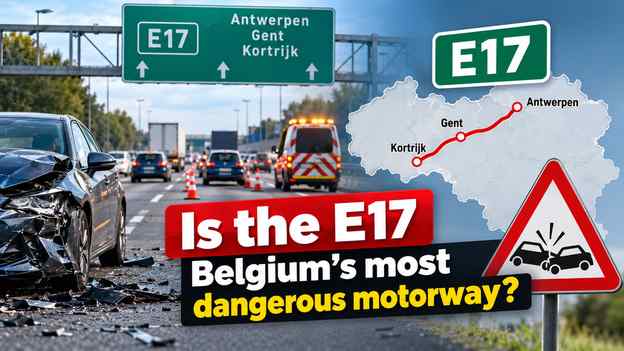
It would be inaccurate to claim that the entire E17 is Belgium’s most dangerous motorway. VRT’s 2021 analysis found the Antwerp ring itself to be the country’s most crash-prone environment, while the E17 sections near Ghent and Zwijndrecht appeared among the notable risk areas. Other motorways—including parts of the E19, E40, E314 and E403—also have serious congestion and collision problems.
The safest interpretation is that E17 risk is concentrated around interchanges, tunnel approaches, roadworks and recurring queues. Long rural stretches with steady traffic may be less demanding, but no motorway section is risk-free.
Frequently asked questions
Which E17 section is considered the most dangerous?
The approaches near Zwijndrecht and Antwerp’s Kennedytunnel are among the most challenging because of intense traffic, multiple merges, lane changes and tunnel-related congestion. The Destelbergen–Gentbrugge area and Deinze–De Pinte are also recurring concern areas.
Are these rankings based on current 2026 crash statistics?
No single official, continuously updated ranking for E17 sections was identified. The best-known detailed comparison comes from VRT’s analysis of January 2020 to May 2021 crash reports. More recent Flemish Traffic Centre reports confirm high traffic and congestion but do not publish an equivalent E17-only ranking.
When should I avoid the E17?
Weekday morning and evening rush hours are usually the most demanding. Heavy rain, winter darkness, holiday weekends and active roadworks can increase risk at any time.
What should I do if I encounter a traffic jam?
Slow down early, activate hazard lights if you are the last vehicle in a rapidly forming queue, keep a safe gap and monitor mirrors for approaching traffic. Never use the emergency lane to bypass congestion.
Can navigation apps prevent E17 accidents?
They can warn about crashes, congestion and closures, but they cannot replace observation. Treat app alerts as supplementary information and obey Belgian road signs, speed limits and police directions.
Final verdict
The most hazardous E17 driving environments are concentrated around Antwerp’s Zwijndrecht–Kennedytunnel approaches, the Destelbergen–Gentbrugge works corridor, Deinze–De Pinte and busy Ghent interchanges. Their common pattern is clear: high traffic, frequent merging, speed differences, temporary layouts and queues.
For Indian visitors and residents driving in Belgium, the best protection is predictable behaviour—plan lanes early, maintain generous distance, reduce speed in rain and treat every queue as a potential hazard.