Good agricultural land is protected in Flanders through a combination of spatial planning, restrictions on development, soil and water rules, farm-support conditions, and land-management tools. The central aim is not simply to keep land labelled as “agricultural,” but to preserve productive, accessible and workable farmland for active farmers.
For Indian readers, this topic is relevant as a useful European example of how a densely populated region balances food production with housing, infrastructure, industry, water security and environmental goals. It is not a consumer-technology purchase topic, so there are no Indian prices, retailers or product specifications to compare. The real question is how Flanders prevents valuable farmland from being permanently lost or degraded.
Why agricultural land needs active protection in Flanders

Flanders is highly urbanised, with strong pressure on open land from homes, roads, commercial sites, recreation and non-farm uses. Agricultural land is more than an empty space awaiting another purpose: it supports food production, rural businesses, water infiltration, biodiversity and carbon storage.
In 2025, Flemish agriculture and horticulture worked about 613,811 hectares, roughly 45% of Flanders’ land area. Yet legal zoning and actual use do not always match. Some land designated for agriculture is occupied by roads, buildings, gardens, sports uses or other activities, while some farmed land lies outside agricultural zoning.
That distinction matters. A plot can be legally protected as agricultural land but still lose practical value if it becomes fragmented, paved over, difficult to access or too costly for a farmer to rent or buy.
1. Spatial zoning is the first line of defence
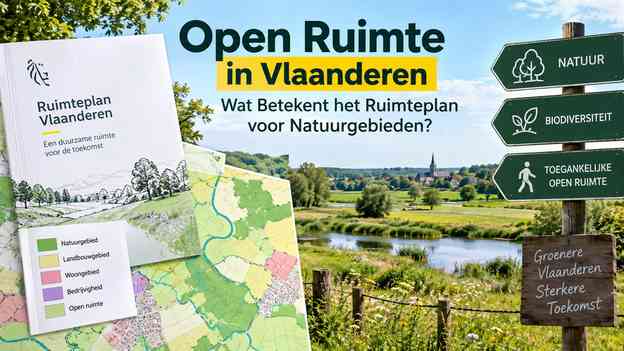
The most important protection begins with land-use planning. Flanders uses spatial plans to identify where agriculture, housing, industry, nature and recreation belong. Land designated as agricultural area is intended primarily for farming and related activities.
This does not mean every construction or activity is automatically prohibited. However, a proposed development in agricultural zoning must fit the permitted purpose and usually requires planning permission. Authorities assess whether it is compatible with the area’s agricultural function and the wider open landscape.
The Flemish Agency for Agriculture and Fisheries has an advisory role in many planning and permit processes. Its involvement helps ensure that the effect on farming is considered before a project goes ahead. This can include concerns such as:
- Loss of productive soil
- Fragmentation of farm plots
- Reduced access for tractors and machinery
- Conflicts between farm activity and nearby homes
- Pressure on land prices and leases
- Damage to drainage, water systems or rural roads
Protecting land through zoning is especially important because sealed soil is difficult and expensive to restore to productive farmland.
2. The “bouwshift” seeks to limit further land take
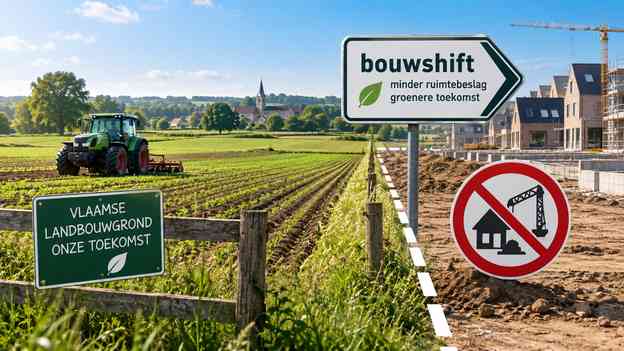
Flanders’ long-term spatial policy includes the bouwshift, often translated as a construction shift. Its broad purpose is to use existing built-up areas more efficiently and reduce further pressure on open space.
The policy direction is to bring net additional land take down to zero hectares per day by 2040. In practical terms, this means new development should increasingly be accommodated within existing built-up areas rather than expanding into agricultural or natural land.
It is important to understand this correctly: the 2040 ambition is a policy target, not a simple blanket ban on all new construction. Individual plans and permits still matter. But the direction is clear: open land should not be treated as an unlimited reserve for urban expansion.
The approach also addresses soil sealing. Paving and construction reduce the land’s ability to grow crops, store carbon and absorb rainwater. This is a serious issue in a region facing both heavy rainfall and periods of water shortage. Flanders also aims to reduce sealing in open-space designations, including inappropriate non-agricultural use within agricultural areas.
3. Protecting “good land” means protecting soil quality
A field may remain in agricultural use yet still become less productive. That is why land protection also involves soil health.
Good agricultural soil needs structure, organic matter, biological activity, nutrient balance and the capacity to absorb and retain water. Compaction from heavy machinery, erosion, poor crop management, excessive nutrient loss and prolonged bare soil can all weaken long-term productivity.
Under the EU Common Agricultural Policy, farmers receiving relevant support must meet conditionality requirements. In Flanders, these include standards connected with climate, water, soil and biodiversity.
Key measures include:
| Protection area | How it helps farmland |
|---|---|
| Minimum soil cover | Reduces erosion and nutrient loss after harvest |
| Crop rotation | Supports soil health and reduces dependence on a single crop cycle |
| Erosion-control rules | Limits soil wash-off from vulnerable sloping fields |
| Buffer strips near watercourses | Helps prevent nutrient and sediment runoff |
| Water and nutrient rules | Protects soil and surrounding groundwater or surface water |
For example, minimum soil-cover measures can require growers to retain crop residues, keep stubble, or establish cover crops during vulnerable periods. These practices help prevent rain from washing away topsoil and can improve organic matter over time.
4. Erosion measures keep productive topsoil on the field
Topsoil is one of the most valuable parts of agricultural land, but it can be lost quickly during intense rain. Erosion is a particular concern on sloping parcels and in areas with erosion-sensitive soils.
Flemish rules map erosion sensitivity at parcel level. Farmers working highly vulnerable plots may need to use specific practices, such as adapted tillage, grass buffer strips or other structural measures.
These measures work in several ways:
- Vegetated strips slow runoff and capture sediment.
- Cover crops shield bare soil from rain impact.
- Better tillage choices reduce soil disturbance.
- Field layouts can be adapted to the slope and direction of water flow.
- Small landscape features can hold water and soil back.
The benefits extend beyond the individual farm. Less soil runoff means fewer muddy roads, cleaner watercourses, lower flood risk downstream and better crop productivity in the years ahead.
5. Water-quality rules protect land and farming capacity
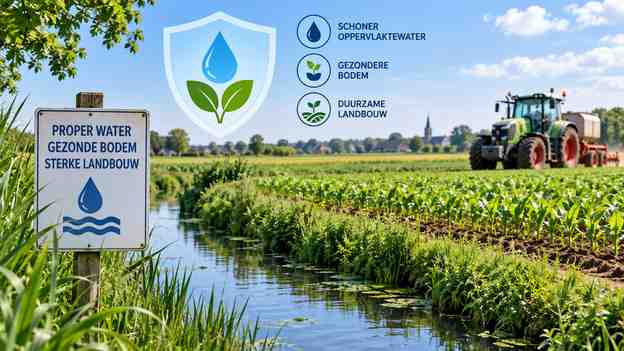
Flanders also protects agricultural land through nutrient and water policy. Farming depends on clean water and healthy soils, but nutrient losses can harm groundwater and streams. In response, rules govern fertiliser use, manure management and crop practices in sensitive areas.
The updated manure-policy framework, often referred to as MAP 7, includes measures aimed at improving water quality in agricultural regions. Some requirements are area-specific, reflecting local water conditions and the risk of nitrate pollution.
Protection strips alongside watercourses are one practical example. Depending on the parcel and local classification, farmers may need to maintain strips where fertiliser use or cultivation is restricted. These strips can reduce nutrient runoff, trap sediment and support biodiversity.
This is not merely an environmental compliance issue. Poor water quality can lead to tighter restrictions, higher costs and lower flexibility for farmers. Better nutrient stewardship therefore helps preserve the economic usefulness of agricultural land as well as its environmental condition.
6. Land consolidation helps farms remain workable
Farmland protection is not only about preserving the number of hectares. A farm also needs land that is reachable, sufficiently large, sensibly shaped and close enough to operate efficiently.
Scattered, narrow or poorly connected plots can increase fuel use, machinery time and operational costs. Land consolidation and land-infrastructure projects can help reorganise parcels, improve access and make farming more practical.
The Flemish Land Agency uses tools such as land exchanges, purchases and transfers through the Vlaamse Grondenbank. Farmers may be able to sell, buy or exchange land through this system in certain circumstances.
These tools are particularly useful where public projects, nature restoration, flood-control works or infrastructure affect farm parcels. Rather than leaving a farmer with an unworkable remainder, land exchanges can help create a more viable farm structure.
7. Access for active farmers matters as much as ownership
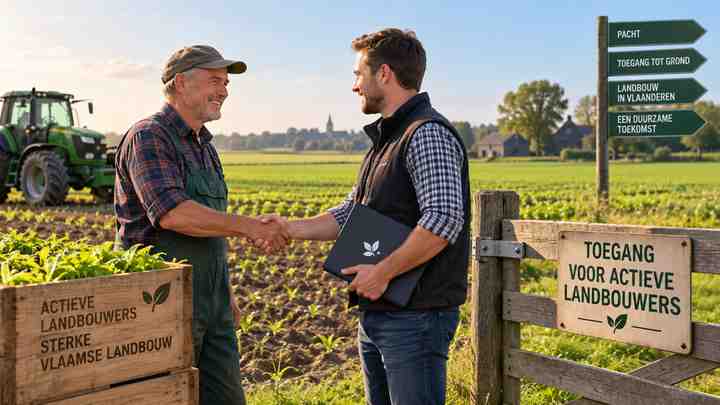
A protected plot is not automatically available to a farmer who needs it. Agricultural land can face competition from investors, hobby uses, horse paddocks, gardens and other non-farming activities. Rising land values can make expansion difficult, especially for young farmers.
This is why current policy discussions increasingly focus on affordable and long-term access to land for active farmers. Leasing arrangements, public-land management, land banks and exchange mechanisms can all influence whether agricultural land remains part of a functioning food-production system.
For a farm, security of access matters because improvements to soil health, drainage, crop rotation and agroecological practices often take years to deliver their full benefit. Short or uncertain access can discourage long-term investment in the land.
What protection does not guarantee
Agricultural designation is valuable, but it is not a complete solution. Several challenges remain:
- Land may be legally zoned for agriculture but used for non-agricultural purposes.
- A plot can remain farmed while soil quality declines.
- Climate change can increase drought, flooding and erosion risks.
- Nature, water, housing and agriculture can compete for the same scarce space.
- Farmers may struggle to access land even when it is technically available.
Effective protection therefore needs coordinated planning, enforcement, soil stewardship, fair access and dialogue between farmers, local authorities and environmental organisations.
What Indian readers can learn from the Flemish approach
Flanders demonstrates that agricultural land protection works best when it is not treated as a single land-record issue. The system connects spatial planning with soil conservation, water governance, farm economics and long-term access.
The transferable lesson is straightforward: preserving farmland requires both quantity and quality. A country can retain agricultural acreage on paper while losing its most productive soils, breaking up farm parcels or making land inaccessible to working farmers.
For policymakers and landowners alike, the strongest approach is to protect the soil, prevent unnecessary conversion, maintain water resilience and keep viable land in the hands of active cultivators.
Frequently asked questions
Is all agricultural land in Flanders protected from construction?
No. Agricultural zoning provides significant protection, but it is not an automatic ban on every project. Proposed activities and buildings are assessed through planning rules and permit procedures.
What is the bouwshift in Flanders?
The bouwshift is a spatial-policy direction designed to reduce further land take and preserve open space. Flanders aims for net additional land take of zero hectares per day by 2040.
How does Flanders protect soil from erosion?
Measures include erosion-risk mapping, minimum soil cover, adapted tillage, crop residues, cover crops and buffer strips. Requirements can be stricter on erosion-sensitive parcels.
Why are buffer strips important on farmland?
Buffer strips reduce sediment and nutrient runoff into watercourses. They can also support water quality, biodiversity and erosion control.
Can farmers exchange land in Flanders?
In certain cases, yes. The Vlaamse Grondenbank can support land purchases, sales and exchanges, particularly where land reorganisation can improve agricultural viability or support public projects.
Is land zoned for agriculture always used by farmers?
No. Legal designation and actual land use can differ. Some agricultural-zone land is occupied by roads, buildings, gardens or other non-farm uses, which is why monitoring and enforcement remain important.