A threatening email, social-media post, phone call or message aimed at a school must be treated seriously—but not handled through panic or guesswork. For schoolveiligheid Vlaanderen, the priority is clear: protect students and staff, preserve the evidence, contact the right emergency services, and let police-led threat assessment guide major decisions.
This guidance is relevant to Flemish schools, school boards, teachers and parents. For Indian readers with children studying in Belgium or managing international education operations, it also explains why a school may temporarily change normal routines after a threat without immediately sharing every detail.
The first rule: do not assess a threat alone

A school director, teacher or IT administrator should never be expected to decide independently whether a threatening message is credible. Even messages that look anonymous, poorly written or copied from elsewhere can cause serious disruption and may contain information that investigators need.
When there is an immediate danger, a specific location, a stated weapon, suspicious activity on site, or a reason to believe someone may act soon, call emergency services immediately:
- 101 for urgent police assistance in Belgium
- 112 for emergency assistance, including police, fire or medical help
Be ready to provide the school’s exact address, what was received or observed, when it happened, whether anyone may be at risk, and a callback number. Belgian emergency guidance stresses the importance of staying calm, giving precise location details and answering the operator’s questions.
For non-immediate concerns, the school should still contact its local police zone promptly through its established school liaison or official local channel. Every local police zone in Flanders has a designated contact point for schools, intended to support collaboration on prevention, safety and youth-related incidents. Vlaanderen’s school-police contact guidance
What counts as a threatening message?
A threat does not need to mention a bomb or weapon to require attention. Schools should escalate messages that include:
- A stated intention to hurt a person, group or the school
- A date, time, location, named target or method
- References to weapons, explosives, fire or violence
- Images, videos or posts showing preparation for harm
- Extortion demands, such as payment in cryptocurrency
- Repeated harassment, stalking or targeted threats against a student or staff member
- Information about a suspicious object, person or vehicle near the campus
The correct response is not to label every case as identical. A vague insulting message and a detailed threat require different operational measures. However, both should be documented and reported through the school’s escalation process. Police and relevant authorities are best placed to judge credibility, context and risk.
In April 2024, Belgium’s National Crisis Centre stated that it treats information about threats seriously and requests an assessment from OCAD, the country’s threat-analysis body, when appropriate. Protective measures are then communicated to the relevant police services. National Crisis Centre update
Immediate response: a practical first-hour checklist
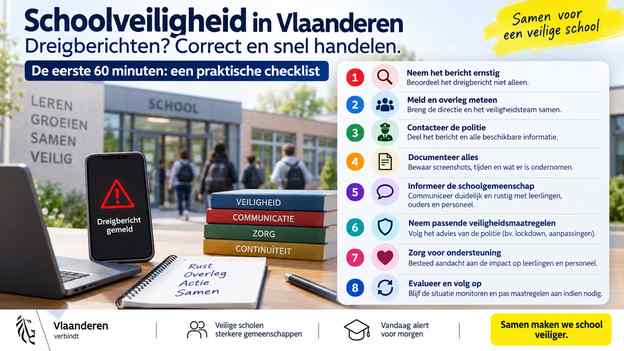
The first hour is about safety, evidence and disciplined communication—not amateur investigation.
| Priority | What the school should do | What to avoid |
|---|---|---|
| Protect people | Call 101 or 112 if there may be immediate danger; follow police instructions. | Assuming an evacuation, lockdown or closure is necessary without consulting authorities, unless there is an immediate life-threatening reason. |
| Preserve evidence | Save the original email, post, URL, username, screenshots, time stamps and call details. | Deleting the message, replying impulsively or editing screenshots. |
| Activate leadership | Notify the director and the pre-assigned crisis team. | Letting multiple staff members issue separate instructions. |
| Control access | Follow the internal emergency plan; account for people if instructed. | Sending staff or students to search for suspicious objects. |
| Communicate carefully | Send one factual, approved update to staff and families when appropriate. | Sharing rumours, suspect names or unverified details online. |
If a suspicious object is found, do not touch, move or open it. Keep people away, contact emergency services and follow their direction. A school should not conduct its own building search if police advise otherwise.
Preserve digital evidence without spreading the threat
Threatening messages often arrive through smartphones, school email accounts, gaming platforms, social networks or anonymous messaging services. Digital evidence can be lost quickly, especially when a post is deleted or an account changes.
The staff member who receives the message should preserve:
- The full message, including sender address or account handle
- Date, time and platform details
- Any attachments, links, photos or voice notes
- Screenshots that show the full context, not only a cropped sentence
- Names of anyone who received, forwarded or witnessed the content
Do not forward the message widely to staff WhatsApp groups or parent groups. That can create fear, compromise an investigation and unintentionally amplify harmful content. Access should be limited to the director, crisis team, IT lead where needed, and police.
Where a message appears to be phishing, extortion or malicious email rather than an immediate physical threat, it may also be appropriate to forward it to Belgium’s suspicious-message reporting channel, verdacht@safeonweb.be. Never pay a demand or click unfamiliar links simply to “check” whether a threat is real.
Evacuation, lockdown or staying open: who decides?
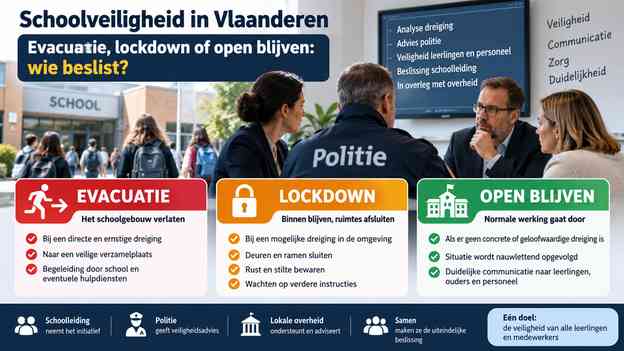
One of the hardest questions in a school threat incident is whether to evacuate, lock down, close the school or continue lessons. There is no universal answer, because the safest action depends on the nature of the threat, building layout, current location of students and the advice of emergency services.
A threat involving a possible device inside a building may make evacuation appropriate. A danger outside the campus may instead require controlled access, sheltering in place or a police-directed lockdown. Moving a large group of children without coordination can create new risks, which is why schools should follow their emergency plan and police instructions.
Flemish education institutions are required to maintain a current emergency plan with preventive measures for possible crises. The official resource recommends tailored action cards, updated contact information, regular practice and clear communication procedures. Emergency planning for education institutions
A well-prepared plan should identify:
- Who takes operational command until police arrive
- How to contact emergency services and local police liaison officers
- Primary and alternative assembly points
- Procedures for attendance and missing-person checks
- How to support students with disabilities or medical needs
- Who communicates with parents, staff and media
- How access, visitor records and student release are controlled
Communicating with parents without causing panic
Parents deserve timely information, but early messages should be factual and brief. The school should say what is known, what action has been taken, what parents need to do, and when the next update will come.
A useful first message might state that the school has received a concerning message, informed police, activated its safety procedures and will provide further information through official school channels. If parents are asked not to come to the campus, that instruction should be clear. Large numbers of parents arriving at a school can obstruct emergency vehicles and complicate safeguarding.
Avoid publishing unverified claims such as “the threat is a hoax,” “the suspect is a student,” or “the school is completely safe.” Those statements may later prove inaccurate. Schools should also avoid sharing information that police ask them to withhold for investigative reasons.
The Belgian National Crisis Centre advises people to rely on official channels and not circulate unverified information during emergencies, as rumours can worsen the situation and hinder responders. Guidance on sharing correct information
Supporting students and staff after the incident
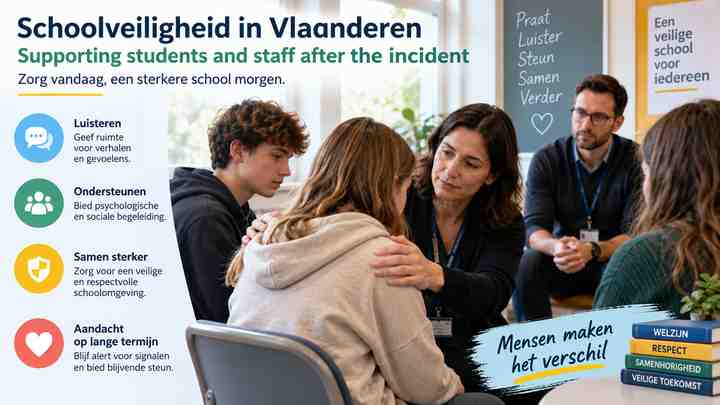
The operational danger may end quickly, but anxiety can remain for days or weeks. Students may have seen alarming posts, heard rumours or experienced an unexpected evacuation. Staff may feel responsible for decisions taken under pressure.
After police clear the immediate phase, the school should:
- Explain, in age-appropriate language, what happened and what is known
- Give students a safe route to report rumours, concerns or screenshots
- Offer access to pastoral support, the CLB or other relevant wellbeing services
- Check in privately with directly targeted students or staff
- Brief teachers on how to answer questions consistently
- Review absenteeism, bullying, online harassment and retaliatory behaviour
- Debrief the incident with police and update the emergency plan
Do not turn a threat incident into a public spectacle or classroom investigation. The goal is to restore a stable learning environment while allowing the authorities to do their work.
Prevention: prepare before a message arrives
The best schoolveiligheid Vlaanderen strategy is not a dramatic response after a threat; it is a tested routine before one arrives.
Schools should keep emergency contact details current, ensure staff know how to report a concern, run proportionate drills, and establish a relationship with the local police contact before a crisis. A familiar working relationship lowers the barrier to reporting and helps clarify who should be contacted in urgent and non-urgent situations.
Schools should also strengthen basic digital hygiene:
- Use multi-factor authentication for school email accounts
- Limit administrator access and review account permissions
- Train staff to recognise phishing and impersonation attempts
- Provide a confidential route for students to report worrying online content
- Keep a clear policy for screenshots, device evidence and privacy
- Teach students not to repost threats, dox individuals or speculate online
A robust response is firm but measured: every threat is logged and escalated, while police and emergency professionals determine the appropriate protective action.
Frequently asked questions
Should a Flemish school close after receiving a threatening email?
Not automatically. The school should contact police immediately if there is possible immediate danger and follow the authorities’ advice. Closure, evacuation, lockdown or normal operation depends on the assessed risk.
Should staff delete a threatening message after taking a screenshot?
No. Preserve the original message and its metadata where possible. Save screenshots too, but do not delete, alter or widely forward the original before police advise on evidence handling.
Can parents collect children immediately during a school threat?
Parents should follow the school’s official instructions. Arriving unannounced can block emergency access and make attendance checks harder. If collection is authorised, schools should use a controlled handover process.
Is a social-media threat less serious than a phone call?
No. The communication channel does not determine the risk. A post, direct message, email, voice note or call should be assessed based on its content, specificity, context and any immediate danger.
What number should a school call for urgent police help in Belgium?
Call 101 for urgent police assistance. 112 can also be used for emergency assistance, including police, fire and medical services.
What should schools tell students after a threat proves non-credible?
Share only confirmed, age-appropriate information. Explain that reporting concerns was the right action, that authorities assessed the situation, and that rumours or social-media speculation should not be spread.