West-Vlaanderen is not yet without a governor, but it could soon face a temporary leadership arrangement. Carl Decaluwé, the current Governor of West Flanders, is due to retire on 30 September 2026, while the Flemish Government has still not announced a successor.
The political impasse is not mainly about whether the role is needed. It is about which governing party gets to put forward the candidate. Vooruit, CD&V and N-VA have conflicting expectations over the post, and the issue has been pushed beyond sensitive Flemish budget negotiations. As of 11 September 2026, no final appointment has been confirmed.
The short answer: why is the appointment blocked?
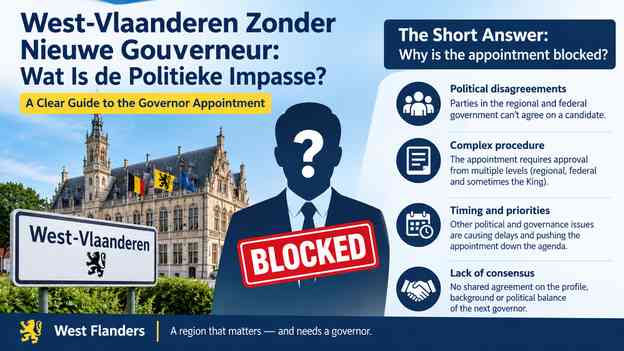
The deadlock stems from a clash between political convention and party ambition.
In principle, the governing coalition uses a proportional allocation method often described as the D’Hondt system to divide major appointments. Under that political calculation, Vooruit is considered to have the first claim to nominate the next West Flanders governor.
However, CD&V wants to retain the post. The outgoing governor, Carl Decaluwé, is associated with CD&V, and the party argues that its strong local presence in West Flanders makes continuity logical. N-VA does not support simply granting the role to CD&V, while Vooruit has not publicly presented a final candidate.
That leaves the coalition with no agreed nominee just weeks before Decaluwé’s retirement.
What is happening with the gouverneur West-Vlaanderen benoeming?
The gouverneur West-Vlaanderen benoeming, or Governor of West Flanders appointment, has become a broader coalition negotiation rather than a straightforward replacement process.
The three Flemish governing parties—N-VA, Vooruit and CD&V—did not settle the allocation of key governor appointments during coalition formation. That omission matters now because two high-profile vacancies are approaching:
| Province | Current situation | Main political complication |
|---|---|---|
| West Flanders | Carl Decaluwé retires on 30 September 2026 | Vooruit’s proportional claim conflicts with CD&V’s wish to keep the post |
| East Flanders | Current governor Carina Van Cauter is due to retire in 2028 | Any trade involving this future post affects N-VA’s expected claim |
A possible exchange—giving CD&V West Flanders while compensating Vooruit elsewhere—looks difficult because East Flanders is itself politically contested. The result is a three-party puzzle in which every concession has consequences for a later appointment.
Why the governor’s position matters
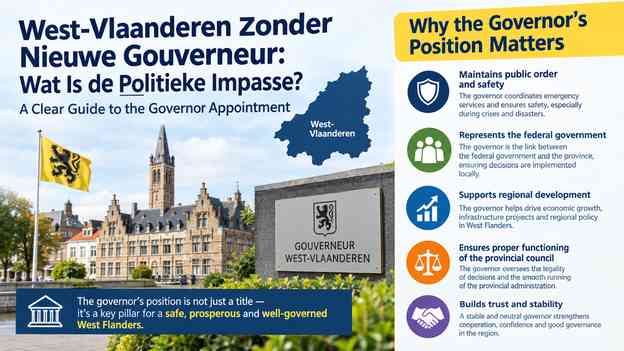
A Belgian provincial governor is not the same as an elected provincial political leader. Formally, the governor is a commissioner of both the Flemish and federal governments.
The position combines administrative, supervisory and crisis-management responsibilities. In West Flanders, the governor’s work includes:
- Maintaining public order at provincial level.
- Coordinating emergency planning and disaster response.
- Supporting coordination among municipalities, emergency services and public authorities.
- Exercising first-line supervision over decisions made by municipalities and public welfare centres (OCMWs).
- Acting as a link between local authorities, the Flemish Government and federal institutions.
For example, during a major storm, flooding incident, industrial accident or security emergency, the governor can play a central role in bringing services and local administrations together. That is why an unresolved appointment is politically awkward, even if public services can continue through an interim arrangement.
The legal appointment process versus the political reality
Legally, the provincial governor is appointed by the Flemish Government, with the unanimous advice of Belgium’s federal Council of Ministers. The office is intended to function above day-to-day party politics.
In practice, however, governors have often been recruited from political backgrounds. That does not mean a governor serves as a party representative after appointment. The role carries duties to act loyally, neutrally and in the public interest. Yet the choice of candidate can still become a politically important decision.
This gap explains the current controversy:
- Formally: the job is an institutional office with a neutral public mission.
- Politically: coalition partners view the nomination as an influential senior appointment.
- Practically: the government needs an agreement before it can complete the formal appointment process.
The D’Hondt approach being discussed is a political allocation convention, not an automatic legal entitlement to the job.
Which names are being discussed?
No new Governor of West Flanders has been officially appointed.
Media reporting has linked CD&V minister Hilde Crevits to the role, though this remains speculation rather than a confirmed nomination. Vooruit has also been reported to be considering its own possible candidate, including provincial deputy Jurgen Vanlerberghe.
The key point for readers following the story is simple: names circulating in political reporting are not the same as an official decision. Until the Flemish Government announces an appointment and completes the required process, there is no confirmed successor.
Why CD&V, Vooruit and N-VA cannot easily compromise
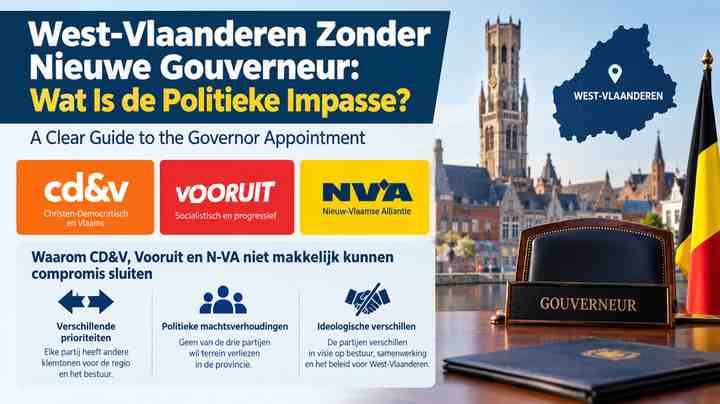
Each coalition party has a rational reason to resist the others’ preferred outcome.
| Party | Broad position in the dispute | Why it matters |
|---|---|---|
| CD&V | Wants to retain West Flanders | The party has deep local roots and sees the province as a natural fit |
| Vooruit | Is seen as having the first proportional claim | Giving up the role without a credible return weakens its negotiating position |
| N-VA | Wants the allocation method respected and the budget process kept separate | It does not want a governor appointment to become a bargaining chip in wider negotiations |
CD&V’s argument is based on provincial political strength and continuity. Vooruit’s argument is based on the coalition’s proportional distribution of major roles. N-VA’s concern is that making an exception now could trigger further demands for compensation later.
This is why the West Flanders vacancy cannot be viewed in isolation. The decision is tied to trust inside the coalition, future appointments and the ongoing budget discussion.
What happens after 30 September if there is no agreement?
The lack of an announced successor does not mean West Flanders will be left without functioning administration or crisis leadership.
Current reporting indicates that the Flemish Government may need a temporary or acting governor arrangement if it cannot settle the permanent appointment in time. Such an interim solution would preserve continuity while the coalition continues negotiations.
A temporary appointment would be politically convenient because it avoids forcing a rushed permanent deal. But it also has drawbacks:
- It prolongs uncertainty over a significant public office.
- It reinforces the impression that a nominally neutral role is being used in coalition bargaining.
- It delays long-term leadership planning for the governor’s services.
- It could make the eventual appointment more closely tied to budget or cabinet negotiations.
The government’s immediate priority is therefore continuity; the larger challenge is settling the permanent political allocation.
Does the delay affect ordinary residents?

For most residents, businesses and visitors, there should be no immediate visible disruption. Emergency services, municipalities and provincial institutions do not stop operating because a permanent successor has not been named.
Still, the issue matters because the governor is an important coordinator during exceptional events. West Flanders has a large coastline, busy transport links, tourism centres, agricultural areas and cross-border coordination needs. Clear leadership and established institutional authority are valuable when a province faces a major crisis.
The dispute is therefore less about everyday service delivery and more about governance, confidence and political accountability.
What to watch next
Three developments will determine how the situation evolves:
- The Flemish budget negotiations: The governor question has been deferred while those discussions continue.
- A possible interim arrangement: If no permanent decision is reached before 30 September, the government may designate an acting governor.
- A package deal on future posts: A compromise may involve wider understandings about future senior appointments, including East Flanders.
Until a formal announcement is made, claims that a specific person has already secured the role should be treated cautiously.
Final view
The phrase West-Vlaanderen Zonder Nieuwe Gouverneur: Wat Is de Politieke Impasse? describes a real and unusually visible political stalemate. The province is approaching a planned retirement without an announced successor because the coalition has not agreed on who is entitled to nominate one.
Vooruit has the strongest claim under the coalition’s proportional logic. CD&V wants to keep a position it has historically held in the province. N-VA is reluctant to bend the allocation framework or mix the decision with budget bargaining.
The likely short-term outcome is continuity through a temporary arrangement. The longer-term question is whether the Flemish coalition can agree on a permanent governor without turning an officially neutral public office into a prolonged political trade-off.
Frequently Asked Questions
Is West Flanders already without a governor?
No. Carl Decaluwé remains the current governor until his retirement on 30 September 2026. The uncertainty concerns who will succeed him after that date.
Who appoints the Governor of West Flanders?
The Flemish Government appoints the provincial governor, with the unanimous advice of Belgium’s federal Council of Ministers.
Is the D’Hondt system legally binding for this appointment?
No. The D’Hondt system is being used as a political convention for distributing important positions among coalition parties. It does not automatically appoint a candidate.
Has Hilde Crevits been confirmed as the next governor?
No. Her name has appeared in political reporting, but no official appointment has been announced.
Could there be a temporary governor after 30 September?
Yes. If the coalition does not agree on a permanent successor in time, a temporary or acting governor can be used to ensure continuity.
Why is East Flanders relevant to the West Flanders dispute?
A future governor vacancy is expected in East Flanders in 2028. Any political compromise over West Flanders may affect which party gets to nominate a candidate for that later role.